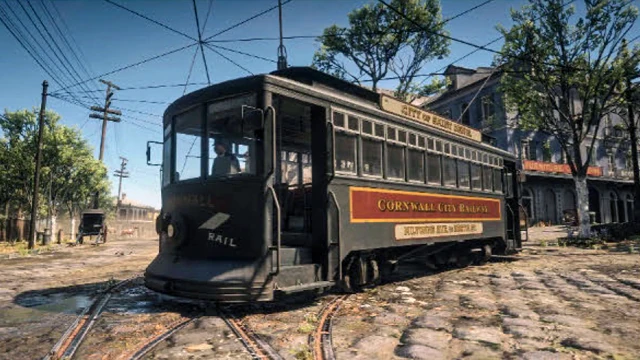

Trolleys, also referred to as trams or streetcars, are a form of rail-vehicle public transportation that travel on tramway tracks in the city of Saint Denis in Red Dead Redemption 2.
Description
Trolleys are a form of cable car only found in the city of Saint Denis, and are a symbol of the city's extensive modernization. Trolleys are used for the mass transit of civilians via cable lines strewn throughout the city. Similar to trains, trolleys operate using tracks, but dissimilarly, trolleys are much smaller, and are typically used for shorter-distance travel. Additionally, trolleys are free of charge, and the player can board and leave whenever they please.
Trolleys operate two separate routes that cover the majority of the city; the Red and the longer Blue Loop, which covers eight stops. The much smaller Red Loop circles around Harris Square in the northwestern part of the city, where the more affluent residents reside, passing through notable structures including the Théâtre Râleur. The Blue Loop is much longer, with stops throughout the commercial district, old quarter, and additional popular locations including the Saint Denis Market and Lemoyne Supreme Court. All trams stop at Frontier Street, by Harris Square, providing an interchange between the two lines.
Schedule
| Red Loop | Blue Loop |
|---|---|
| Milyonne Avenue | Victory Street Station |
| Frontier Street | |
| Harris Square | Lemoyne Supreme Court |
| Harris Square | |
| Hestia Street | Milyonne/Courtenay |
| Milyonne/Rabulione | |
| Chitimacha Street | Saint Denis Market |
| Victory Street Docks |
History
Background
Trolleys are a symbol of the rapid technological growth of Saint Denis at the turn of the 19th century. Operated by the Cornwall City Railway Company, owned by industrial magnate Leviticus Cornwall, the trolley system was an ambitious project aiming to revolutionize public transportation in the city. These sophisticated trams were an innovation that replaced the more traditional horse-drawn carriages, providing a faster, more efficient, and critically, a more consistent mode of transportation that operated regardless of weather under most circumstances.
However, an unexpected blizzard in 1895 tested the limits of this burgeoning transit system.[1] As the snow brought Saint Denis to a standstill, the streetcars were rendered inoperative, overwhelmed by the inclement weather conditions. This event exposed the vulnerabilities of even the most advanced technologies of the era, compelling the city to revert to the use of horses and carriages temporarily.
Events of Redemption 2
Trolleys first play a role in the story of Red Dead Redemption 2 during Chapter 4, particularly in the mission "Urban Pleasures," in which Dutch van der Linde and his gang receives a tip from local crime lord Angelo Bronte regarding the Victory Street Station. Dutch brings Arthur Morgan and Lenny Summers with him to rob the station, but the heist turns out to be a set-up, and the trio are ambushed by hordes of law enforcement. In an effort to flee, the trio hijack a trolley and wreak havoc across the streets of Saint Denis, until the trolley hits a stagecoach and derails. The trio end up successfully fleeing, although the legitimate success of the heist was brought into question with the paltry sum they robbed.
Elsewhere in the story, trolleys play minor roles as forms of transportation, such as when Arthur parts ways with Mary Linton at the end of "Fatherhood and Other Dreams." By 1907, following the assassination of Leviticus Cornwall and the effective disbandment of his subsidiaries, the Pacific Union Railroad Company would instead operate the trams in Saint Denis.
Mission Appearances
Red Dead Redemption 2
Gallery


Trivia
- If the player sits inside the trolley and turns on cinematic mode, the same music that plays during the train cutscenes plays here.
- They resemble the New Orleans Regional Transit Authority 2000-Series trolley cars, albeit way wider. This is inaccurate for the time period, considering they weren't built until the 1990's.
References
- ↑ Mentioned in an NPC conversation- reference to the real-life New Orleans blizzard of 1895 with similar effects.